Checkbook Cover Revival: Fabric Scraps and Mod Podge

Looking for an easy, fun project on a Sunday afternoon to do while you watch football?  I know I am! It has been a rough few days and I am hoping to relax on this lovely sunday and enjoy week one of the NFL games and cheer on our fantasy football team.  I have been on a small blogging hiatus, battling a nasty fall cold and continuing to go on with life as usual, work full-time, and as always, be a wife, and a mommy to a 2 year-old with an un-ending supply of energy.

It was my toddler apprentice who gave me the idea for today’s project.  My daughter was with me in our craft room the other day exploring as usual. She found some great scrap fabric to play with.  It made me think about ways I might be able to utilize these smaller fabric pieces, and then it hit me!  I had a tan checkbook cover that was in need of a revival.

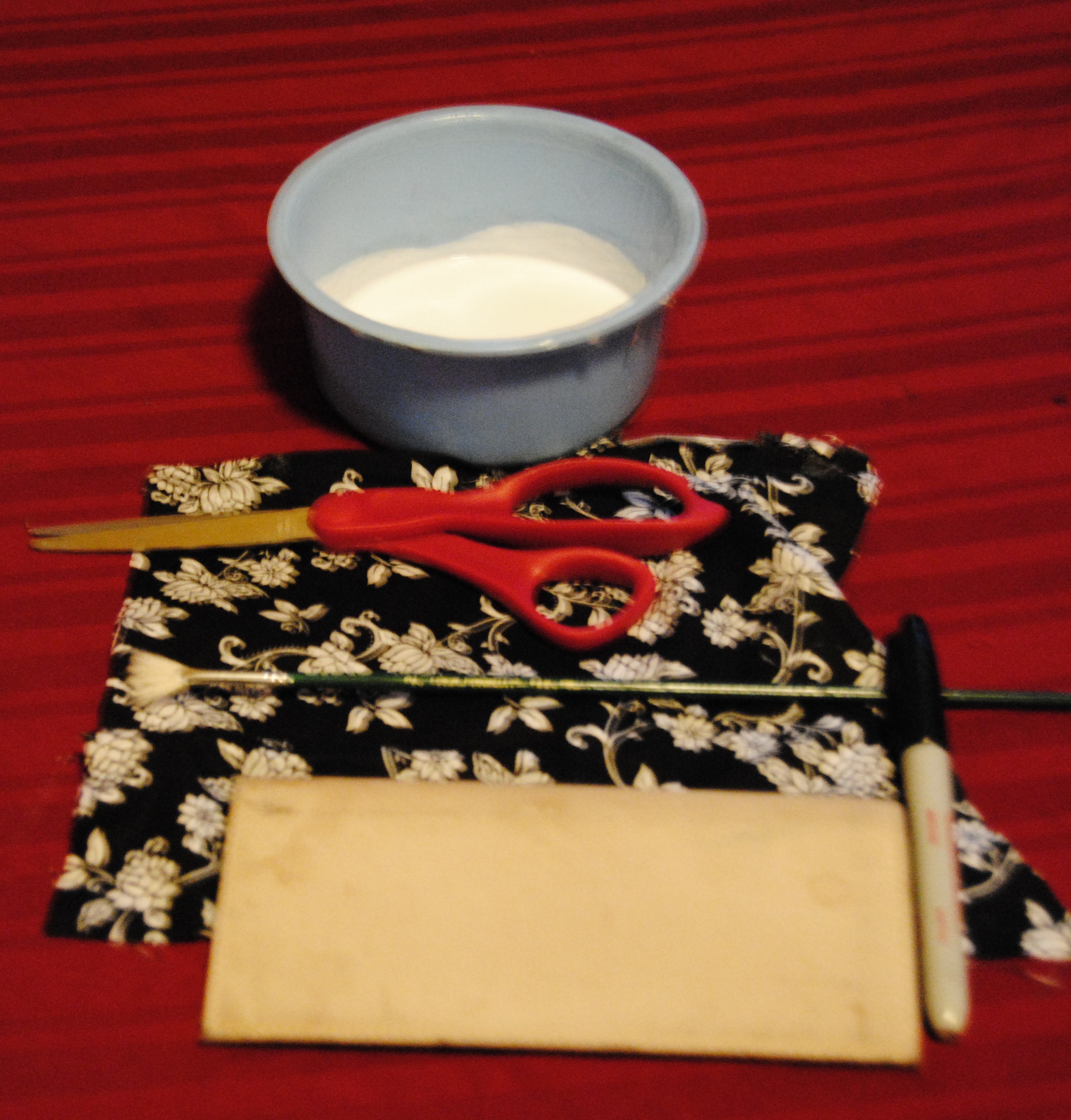
I gathered what I would need:

DSC_0355

Mod Podge

Scrap Fabric

Paint Brush

Black Marker

Scissors

First, I opened the check book cover, laid it out flat and traced it onto the fabric with the black marker.  I cut the tracing, with a pair of scissors and placed aside.  I applied Mod Podge to the outside of the check book cover, generously with a paint brush.

DSC_0358

I carefully applied the fabric to the checkbook smoothing it out with my hands.

DSC_0360

I applied Mod Podge over the fabric and placed the checkbook in front of a fan to dry.

DSC_0361

I repeated this process three more times, which left a nice,  smooth finish on the cover.  I decided to leave the inside as is.  I didn’t want the paper checks to “stick” to the inside cover.  Mod Podge is attracted to paper. (as it should be!)

DSC_0365

What a great way to use fabric scraps and add a little life to your checkbook!

Growing Pains: 7 Mistakes I Have Made “On The Upcycle”

Tonight I thought I would, share with you all a few things I have learned the hard way through crafting, decoupaging, upcycling, and blogging.  It is certainly not as easy as it looks and I have acquired quite a few bumps and bruises along the way!

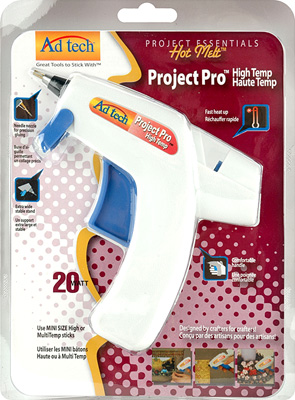
1. High Temperature hot glue guns are as advertised: 

For many years, I used a small low temperature glue gun.  As many of you already know these do not adhere as well as the high temp guns.  I thought I would treat myself, to a newer glue gun.  When I used it for the first time, I inadvertently stuck my hand into the hot  gooiness and boy did I regret it.  It didn’t just burn a little it burned A LOT, and  I adhered two of my fingers together!

High Temp Hot Glue Gun by Ad Tech

2. Mod Podge + Mod Podge =DISASTER:  Mod Podge is a magical substance, but at the end of the day it is simply a glue and adhesive.  When storing furniture made with Mod Podge it is important to not allow two pieces of furniture to be stored in such a way that they “lean” up against each other.  I once had a TV tray that was stuck to a chair, and rip!  Thanks goodness I was able to re-paint and repair the damaged tv tray! Lesson learned!

3. Decoupage over Decoupage = DISASTER:  When decoupaging, always make sure you are adhering to the “flat” original surface of a project and that the material you are using, fabric, paper, ect does not overlap with the same. This creates a uneven surface prone to wrinkles and air bubbles.  If you are decoupaging a material like paper onto a brightly colored surface be sure the material is think enough to prevent the color from “bleeding through.”

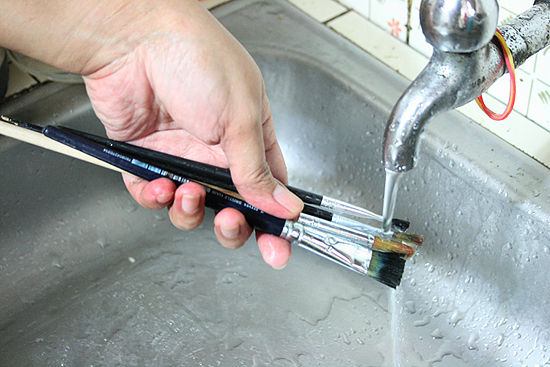
4. Treat your paint brushes as you would want to be treated:  There is nothing worse than projects ruined or further complicated by poorly cared for paint brushes with loose bristles that find their way forever embedded in a project, Or the poorly rinsed brush that streaks the wrong color across the face of a project.  Be sure and keep these clean and inspect occasionally for loose bristles. I use the method to clean my brushes illustrated here on Wiki How.

Paint Brush Cleaning

5. Have a “Crafting Happy Place”:  If possible, I have found it best to have a separate crafting space or at the very least a piece of furniture for crafting you wouldn’t mind getting a few globules of paint on.  No matter how many drop cloths, wipes and sponges you have handy accidents happen and you may not always see a paint splatter or glue glob right away.  I single-handedly over time ruined the surface of our kitchen table.  The bright side you ask? I am planning to cover it with fabric can you say a project? Stay tuned! Ok my craft room looks nothing like these, but a Upcycling Mom can have a dream right?

6.  Thinking about taking the easy way out?  Don’t do it!  Crafting may appear fun, but much of it is hard work:  sawing, cleaning, sanding, priming.  For me this is all preparation and no reward.  I want to see the finished item I envisioned; However these things are important steps often times when creating a quality project that lasts.  Not all items will require the same preparation, but one of the most important and simple steps before painting or decoupage is removing dust and dirt.

7. If at first you don’t succeed: Keep trying!  As much as the cyber blogging world is filled with wonderful people, there are also haters out there that are cruel instead of encouraging.  Always stay true to yourself and believe in what you are doing even if others don’t necessarily approve. Stay positive and don’t let a project fail stop you in your tracks! Don’t be too hard on yourself (So far this has been the toughest lesson of all, but like I said keep trying right?)

Flea Market Bar Cabinet Makeover

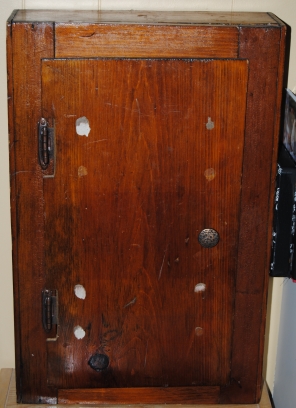
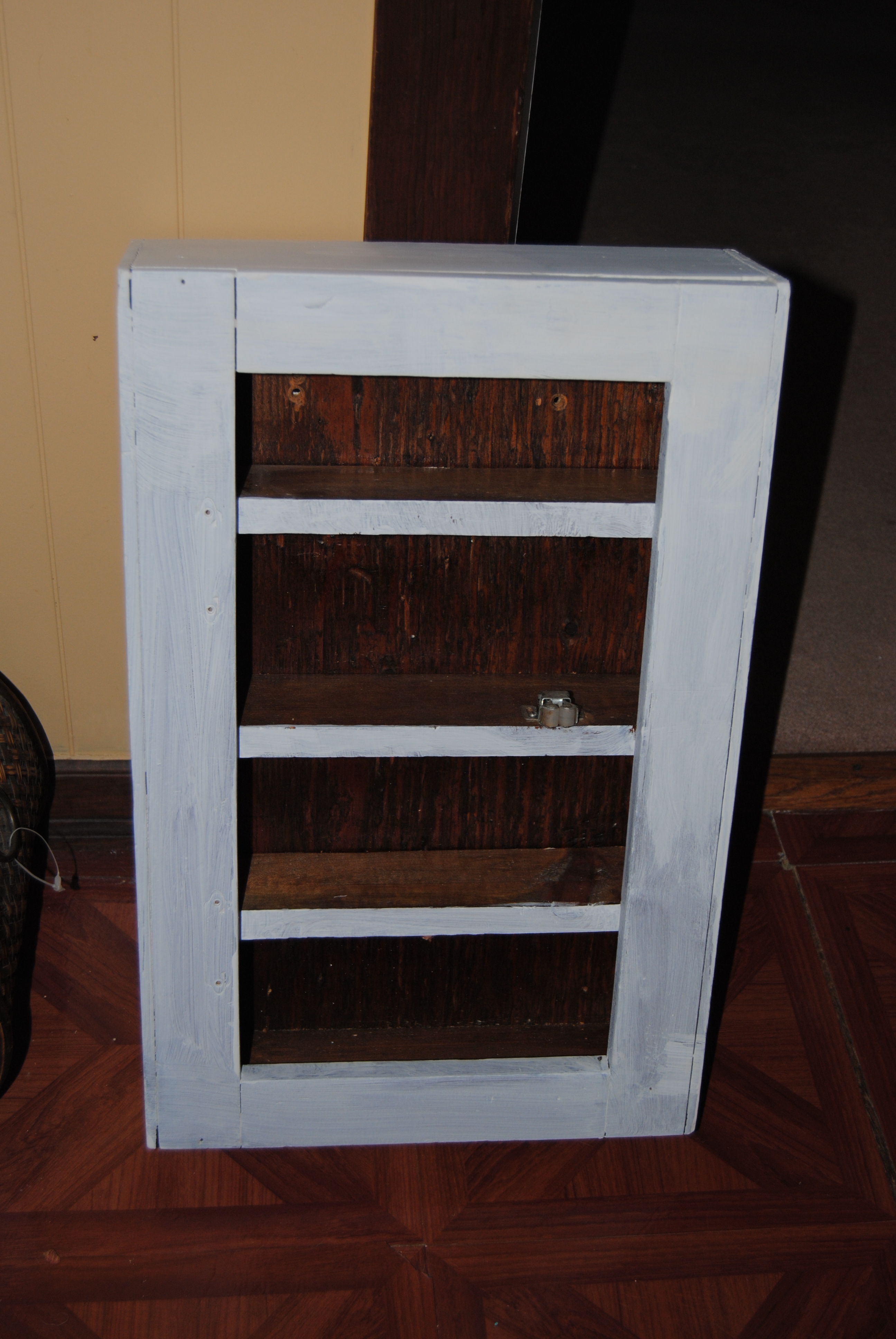
My husband and I picked up this wooden cabinet many years back at a local outdoor flea market.  It  had two mirrored bar signs glued to the door and was a perfect “novelty” cabinet for our bar.  We acquired quite a few shot glasses over time, collecting them as an inexpensive souvenirs wherever we traveled.  This cabinet was a perfect way to store them.

Now that the bar has become a distant memory in our family friendly household, this cabinet sat on the floor in our spare bedroom with the shot glasses still in it increasing the chances of something getting broken. The  signs began to fall off, so I decided to remove them all together.  I planned to restyle this cabinet and hang it in a much safer place-Our kitchen.

Image

I used a scraper, to remove the access glue front the door and cleaned the cabinet with a wet wipe.  I removed the knob and door and set aside.  The cabinet was heavily lacquered so I used a white latex sealer to prime the cabinet before getting started.

Removed door and Primed

I used fabric to cover the outside of the door and glued it to the wood with Mod Podge, I then applied a thick coating of Mod Podge with a Large brush to the top of the fabric.  Once dry, I trimmed the excess fabric away from the door with a pair of scissors.  I painted the entire cabinet with black acrylic paint except for the inside and shelves. Once dry, I applied Mod Podge over the entire piece.  I spray painted the knob white, and once everything was completely dry, I re-attached the cabinet door and knob.

I hung the cabinet in our kitchen by our table, with its much more sophisticated look, It is a great place to store our souvenir glasses!

Restyled cabinet using paint and Mod Podge

Inside wooden shelves

Materials:

Wooden Cabinet

Fabric

Mod Podge

Black acrylic paint

White latex primer

White spray paint

Small and large paint brush

Scissors

Before and After:

Cabinet Re done

A Gift For Mom: Decoupage Sports Team Hand Painted Wooden Tray

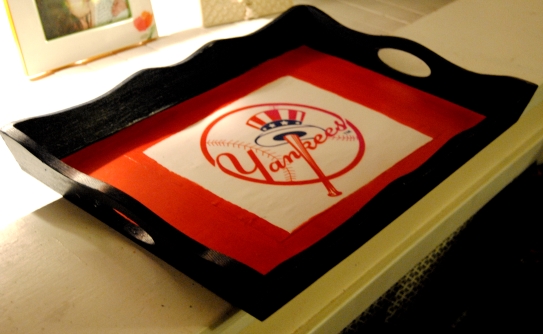
My Mom is a big New York Yankees fan and I wanted to make her something special for her birthday.  I was in Goodwill this past week and came across an unfinished wooden craft tray.  Someone had started to paint the tray, and I could see a pencil outline of a man and a woman in a boat.  Obviously, it was a craft that was started with good intention and never finished.  In my haste to begin this project, I didn’t take a before picture.  There are many wooden trays available at Thrift shops and craft stores.  For an example of this, click here.

The tray was unfinished for the most part and ready to paint. I painted over the previous pencil tracing and paint with a bit of white latex primer before getting started.   I printed the Yankee logo I wanted to use on my printer.  I traced this on to the middle of the tray’s surface.  I wanted to avoid painting this portion of the tray so that the color would not bleed through the print when I was ready to decoupage it on.

I painted the tray’s inside red, and the rest in Yankee’s Royal Blue. I placed it aside and I allowed it to dry in front of a stand up fan.  I then applied Mod Podge to the unpainted area with a foam craft brush in the middle of the tray.  I very carefully applied the print logo to the tray, smoothing out any air bubbles or wrinkles with my hands.  While I allowed this to dry, I touched up any painted areas that needed it. Once completely dry, I sealed the entire piece with Mod Podge.  My Mom loved it and we had lunch yesterday to celebrate her day!  Happy Birthday Mom!

DSC_0303


Materials:

Unfinished Wooden Tray

Acrylic Paint

Mod Podge

Print/Decal

Scissors/foam craft brush

White latex primer (optional)

Decoupage your Cell Phone: Take Two

Back on May 28th, I posted an entry regarding decoupaging your smart phone called Crafting Is Worth The Risk.  At the time it was unknown as to how such a project would turn out.   I actually  loved it, and decided to decoupage my computer tablet as well.   I received so many compliments on my phone case!  If they only knew!  Cell phone cases can be quite expensive, and this is certainly is a thrifty way to add an artistic flare to your phone without spending a lot of money, but what happens  when you decoupage your phone, but need a change?  No problem!

I wanted to change my smart phone’s look to something more colorful.  I loved the scrapbook paper I used on my tablet.  I had a small piece of this paper left and decided to use it to update my phone’s look.  It was fairly easy to remove the old decoupage, I simply peeled it off with my fingers and cleaned the back of the phone cover and removed any of the old dried, Mod Podge.  I was surprised, because the decoupage held up amazingly well, and I didn’t think it would be so easy to remove.   I then repeated the same process I used during my initial restyle.  I removed the back of the phone, and traced this  on to the back of the paper with a pen, and using an X-Acto knife I carefully trimmed the areas such as the speaker and camera lens.  I applied Mod Podge directly to the phone cover to adhere the paper and then applied multiple coats over top to seal.

A few additional phone decoupage tips:

Use Mod Podge Matte finish as the gloss finish I find dries tacky!

Be careful and keep your phone dry (Decoupage or not this is always a good tip!)

Always remove the cover from the phone before you start.  (Don’t want any glue finding its way in any of the phone’s electronic components.)

Do not place a decoupage phone on another decoupaged item such as a table.  The two mod podged surfaces will “stick” to each other!

Before Decoupaging, If your phone is under warranty, be sure and check if altering your phone in any way, could void the phone’s warranty (read the fine print)

For a more detailed tutorial, please see Restyle Your Smart Phone.

Restyle your cell phone/smart phone

IMG_20130829_104925

Tangled No More: Upcycled Wooden Shaker Peg Rack

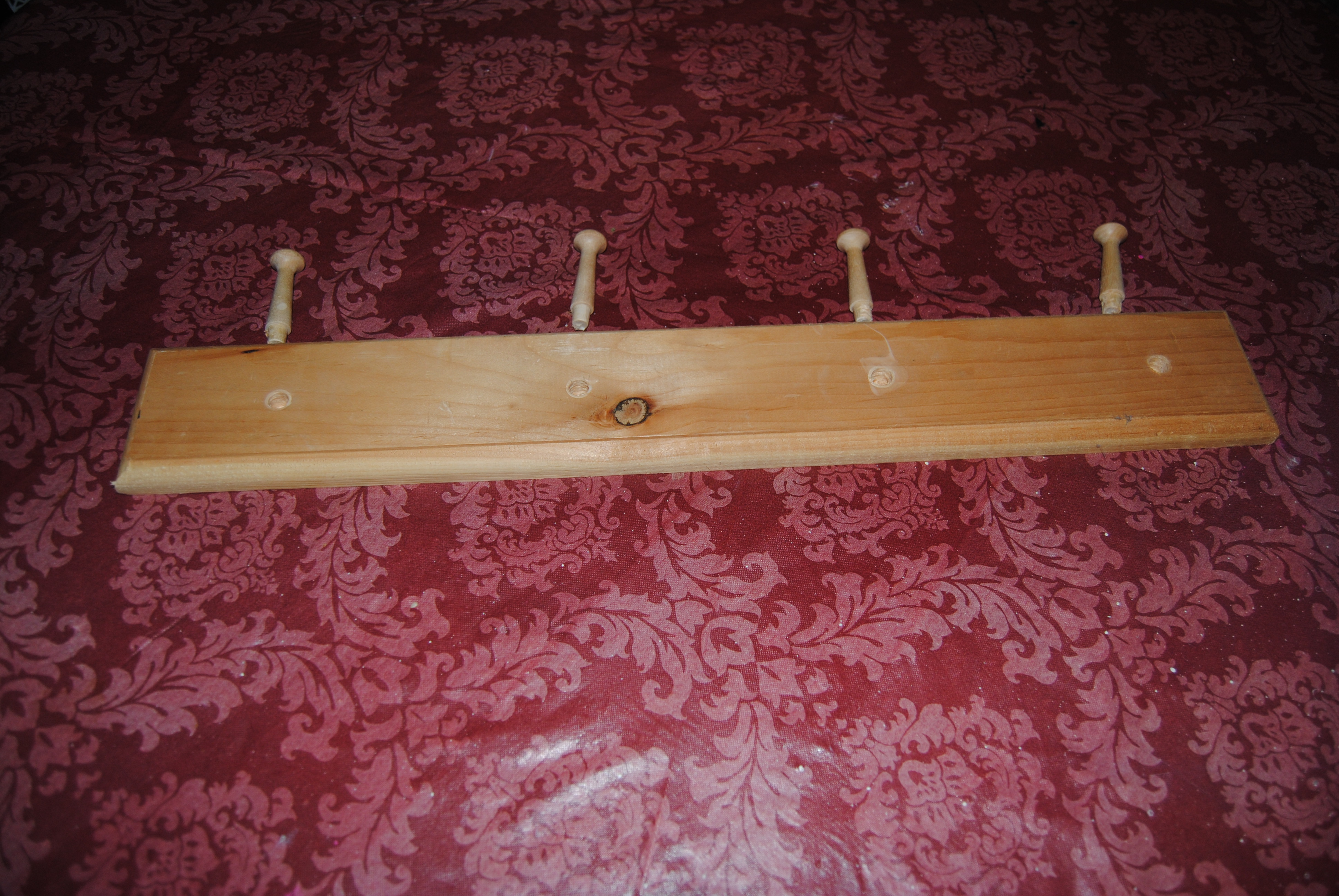
I have a confession.  I am horrible when it comes to keeping my jewelry together and organized. I am always losing earrings,  and I constantly tangle my necklaces together.  When I picked up this Shaker Peg Rack at a thrift shop, I planned on using it to hang “crafty”things in my crafting area. I decided against it when I realized it was more urgently needed in our bedroom for jewelry.    I reached my breaking point this weekend, when I went to change my necklace only to discover a tangled mess!

Image

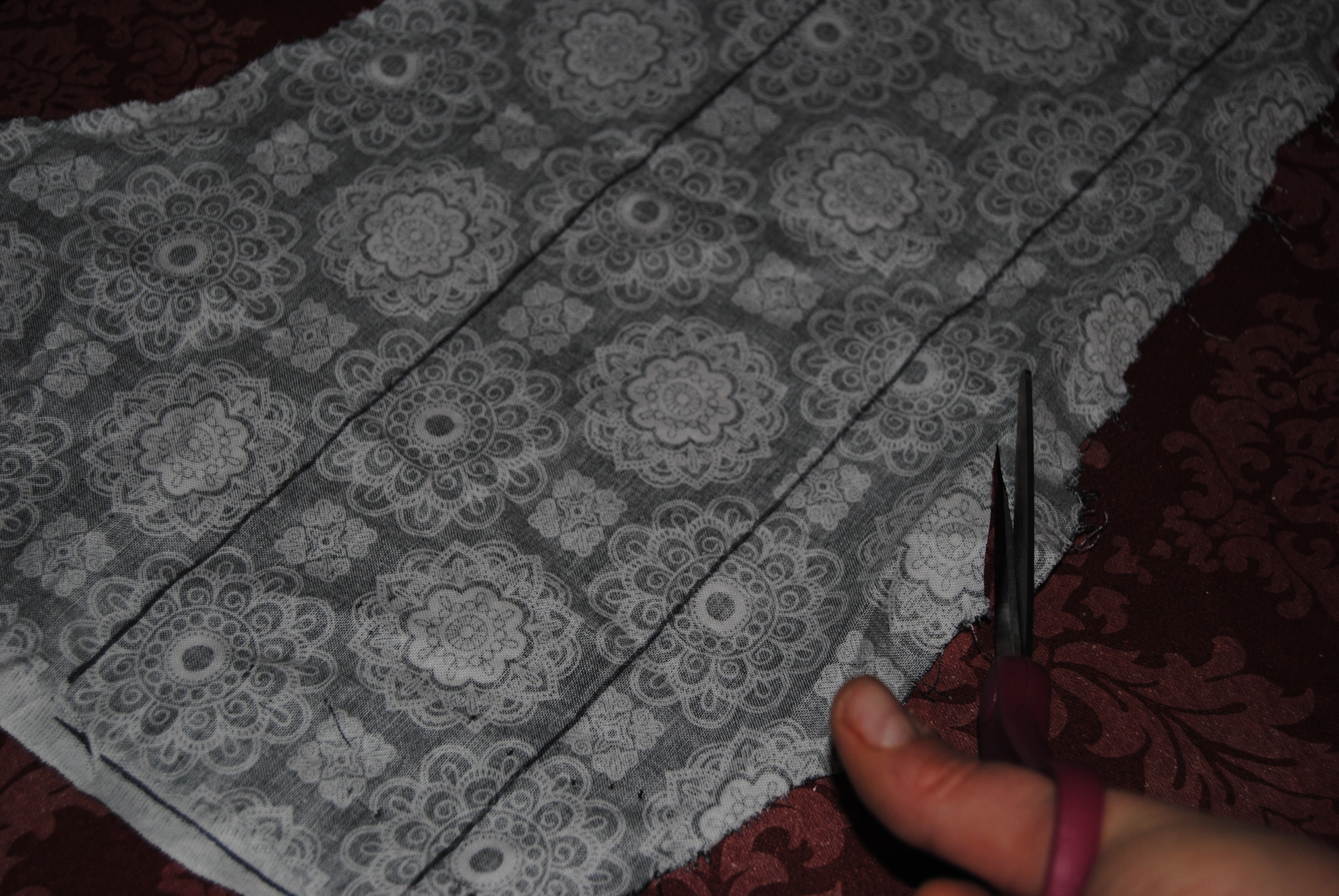
I decided I would use the fabric featured on Upcycled Spaghetti Jar Lamp.  I tried removing the pegs, but needed some of the hubby’s strength to remove them. He was able to loosen them and I was able to finally pop them out. My plan was to glue the pegs back on later. After pulling them out, they still fit snuggly which was great.  Removing the pegs would make it easier when covering the rack with fabric, and it would appear seamless.   I traced the rack surface onto the fabric with a black marker.

DSC_0274

I cut the fabric outline with a pair of scissors.  I placed the fabric aside.  I applied Mod Podge to the wooden rack with a foam craft brush, I carefully applied the cut fabric to the wooden surface smoothing it out on the surface with my hands.  I marked off the spot on the fabric, where the peg holes were.  This way, when dry I could pierce the holes with a scissor tip without making the fabric shift and move. I placed this piece aside to dry and painted the pegs with black acrylic paint.  I painted any areas not covered with fabric black.  Once the paint was completely dry, I covered all the painted and fabric covered areas with another layer of Mod Podge, and glued the wooden pegs back into the holes.  I used two long black screws to mount the jewelry holder to the wall.

This fabric and style looks great in our grey/neutral bedroom. You can use any fabric or color scheme you like and unfinished Shaker Peg Racks can easily be picked up at yard sales and thrift shops for a couple bucks. The perfect upcycle!

Upcycled Shaker Peg Rack Made with fabric, Paint and Mod Podge

Decoupage To The Rescue! Lost Basement Table Gets A Makeover

Last stop before curbside in our house has always been the basement.  This poor glass table had been banished to the basement for seven years, the entire time we have lived in our house!  It was pushed in a corner and with flower pots and miscellaneous basement junk stacked on top of it and covered in spider webs. My husband and I try to keep the basement clean, and clutter free, but it is not always easy.  As much as we dislike our basement’s dampness, cement walls and floors, the spiders seem to love it! That’s good because they help control the other bugs crawling around down there! yuck!  If any item deserved a little TLC, and a makeover it was this table! I cleaned it in our utility sink and brought it upstairs.  The glass was easily removable, and the table cleaned up nicely.

Basement Rolling Glass Table Rescue

I laid out the fabric,  I was using on the floor and traced the glass on to the back of the fabric with a fine tipped marker.  I cut the tracings with scissors, and set the fabric aside. It is amazing that a pair of curtains bought at Goodwill, and originally sold by Ikea has been used in 5 previous projects on this blog! These curtains were a great buy and I still have scrap pieces left.  When I started doing this, I was shocked at the high cost of fabric. I always make sure I take a walk by the linens aisle at the thrift stores. Old bed sheets and curtains are great for  furniture re-styles because of their durability and come in great patterns.  You can still purchase this fabric called “Fredrika” through Ikea here.  I love it! For me, Even though it is modern made, it has a 60’s flower power appeal, and I love the colorful textiles from that era.

DSC_0211

I generously applied the Mod Podge, with a paint brush to the outside of the glass.

DSC_0212

Then, I carefully applied the fabric to the glass, smoothing it out with my hands.  I repeated this three times once for each piece of glass.  I allowed the pieces to dry in front of a fan. Once dry,  I applied Mod Podge over the top of the fabric to coat the surface.  I applied 3 coats to each table top.

DSC_0214

Ta da! The colorful fabric turned a dirty and dusty table bound for the junkyard, into a colorful, and fun piece!  A true basement rescue!

Upcycled Rolling Glass Table Restyled with Ikea Fabric

Stay Calm and Craft- A Simple Wooden Tray Decoupage

Nothing helps me manage stress better than crafting and creating.  When I don’t put my nervous energy to good use, the anxiety levels within me rise.  When I am creating I feel as though my stress levels decrease and my positive energy increases, and I am a better, lesser stressed out version of myself.  When I am working on a piece of art or a craft project, it is one of the few times my mind is clear of all worry and I become completely focused.  I was feeling a bit stressed and this small and simple wooden tray decoupage craft was exactly what the Dr. ordered.

Little Wooden Tray

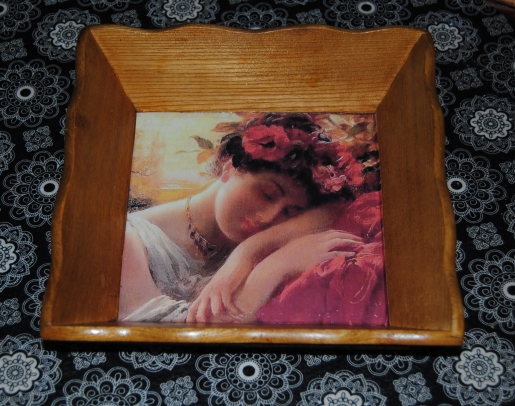
I picked this wooden tray up at A Goodwill store.  It was  marked with a red tag and on this day red tag items were 50% off.  This was a bargain item costing only 50 cents.  The wood on this piece was in very nice condition. I decided not to paint it, I chose a nice piece of Victorian Artwork and traced and cut the print to fit the inside of the tray.  I generously applied Mod Podge with a small foam craft brush to the inside of the tray.  I adhered the print carefully to the tray, smoothing the paper out as I applied it to the wood.  Once dry, I applied two coats of Mod Podge over top of the image to seal it. I used a paper towel and vaseline (works great on wood!) to shine and buff the wood.

Victorian Artwork Decoupage

Ah now that’s better!  Try a simple craft during a stressful day. You won’t regret it!

(and I think our Victorian model would agree!)

Materials:

Printed Art

Small Wooden Tray

Mod Podge

Scissors

Craft foam brush

Vaseline/cloth or paper towel

Upcycled Decorative Jar Lamp: Take Three

Upcycled Decorative Jar Lamp


It all started with a spaghetti Jar, a broken lamp and a upcycle idea.  I found myself making a third decorative fabric covered glass jar lamp tonight.  (See Decorative Lamp # 1 and #2 to read tutorials on how I make these jar lamps.) I enjoy making these because each one turns out unique and the style possibilities are endless when it comes to the different fabrics you can use.

I also had the chance to work on a few smaller projects and organizing my craft space.  I decided to use the same sheet  I used for Cloth Covered Galvanized Bucket.  The Lamp is being displayed in a built-in vanity in our hallway that displays a special family blue vase.  The light this lamp omits illuminates the vase nicely and it is pleasing to the eye as you walk up our stairs.  Upon further inspection today, on a trip up to our attic, I stumbled across more of these “nightlight bulb lights”  These certainly will come in handy for future luminary crafts!

Upcycled Decorative Jar Lamp Reflection


Hooray for Cloth Covered Galvanized Buckets!

I picked up this little galvanized metal bucket for a couple bucks at Goodwill.  As mentioned in a previous post, I am working on creating a small crafting space in our spare bedroom.  At the moment,  I am particularly interested in items that can assist in organizing this space. Although many of these storage items can be made from cans, jars, and boxes,  I couldn’t resist this cute little bucket. Organizing this room is not an easy task as the job requires moving a few larger items from the room and up into the attic, small steps…

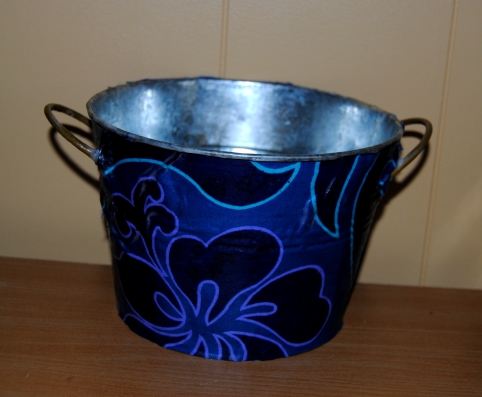
I decided to try to decoupage this bucket.  I saw some examples online and liked the look.  I realize some may prefer the bucket without decoupage, but since I was making it for a craft room, I wanted to make it fun and experiment.  It also gave me the opportunity to use Mod Podge for the first time on metal.  I had this great old bed sheet, colorful and fun.   I thought it would be perfect for this bucket and would contrast nicely with the silver metal.

I cut off a piece of fabric and wrapped it around the bucket and trimmed off any access fabric.  I used a foam craft brush to apply Mod Podge to the outside of the bucket.  I then very slowly applied the fabric smoothing it out with my hands,  after it dried I applied 4 coats of Mod Podge allowing to dry between coats.  It dried with a few wrinkles, but it was a bit of a challenge due to the handles to perfectly wrap the fabric around the bucket.  Despite this, the bucket will come in handy for various craft supplies and provide the durability of galvanized metal.

Decoupage Galvanized Buckets